With a population of 285 million, an economic growth rate of 5.61%, and internet penetration exceeding 80%, Indonesia is the largest single market for the digital economy in Southeast Asia. However, another fact cannot be ignored: 66% of Indonesian adults have encountered digital fraud, the Ministry of Communication and Digital Affairs deleted 4.2 million pieces of negative content within 18 months, and operators have an interception rate of over 70% for SMS messages without a registered Sender ID. On one hand, there is a massive digital dividend; on the other, increasingly tight regulatory pressure——In 2026 Indonesia, is SMS and voice marketing still worth doing? How can it be done to avoid interception, complaints, and truly reach users?
Regarding the in-depth analysis of the Indonesian SMS and voice market, we will divide it into two parts. This article, as the first part, will focus on deconstructing Indonesia's economic foundation, the competitive landscape of operators, and the key trends and challenges facing SMS and voice. The second part will focus on five core application scenarios and communication service solutions.
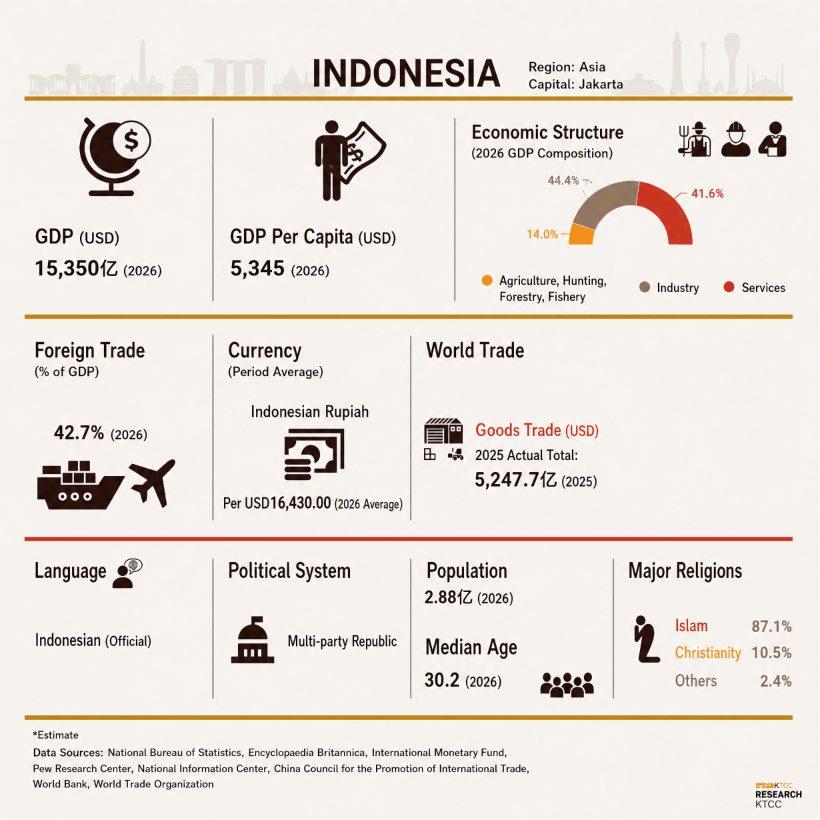
Economic Foundation and Digital Ecosystem: A "Mobile-First" Consumption Empire of 285 Million People
To understand SMS and voice marketing in Indonesia, one must first understand its digital foundation.
Population and Growth. Indonesia is the world's fourth most populous country, with a total population of approximately 285 million as of early 2026. According to data from the Indonesian Bureau of Statistics (BPS) for the first quarter of 2026, GDP grew by 5.61% year-on-year, hitting a thirteen-year high for quarterly growth and exceeding market expectations of 5.40%. The IMF predicts a full-year growth rate of about 5.1% for 2026, with domestic consumption as the core engine.
Comprehensive Mobile Internet Penetration. DataReportal shows that internet penetration in Indonesia has reached 80.7%, with approximately 188 million smartphone users. Users spend an average of 7 hours and 22 minutes online via mobile daily, higher than the global average. The number of mobile cellular connections exceeds 331 million, equivalent to 116% of the total population, with individuals holding an average of more than 1.5 SIM cards——this is both a broad touchpoint for digital marketing and the root cause of strict risk control by operators.
Mature Payment Loop. The three major e-wallets, GoPay, DANA, and OVO, cover over 80% of online payment scenarios, and the QRIS unified QR code has 57 million users. The path from "seeing a message" to "completing a transaction" is extremely short, provided the message can be successfully delivered.
Summary: Indonesia does not lack users or consumption intent; what it lacks is secure, compliant, and high-arrival communication reach. Behind every intercepted SMS is a lost order and lost trust. Professional service providers deeply rooted locally, like Laaffic, are filling this gap.
II. Major Operators and Competitive Landscape: Three Giants, Each Setting Barriers
From a macro perspective, the Indonesian Information and Communication Technology (ICT) market size reached $50.2 billion in 2025 and is expected to maintain a compound annual growth rate of approximately 14.45% between 2025 and 2033. In the A2P SMS market, the share of SMS business in the Indonesian CPaaS market was as high as 38.51% in 2025, fully indicating that SMS remains a core infrastructure in business communication. By the end of 2026, Indonesian internet users are expected to reach 241 million, with penetration rising to 86.5%.
However, due to Indonesia's vast archipelagic geography, a large number of mobile connections are the necessary path for marketing to reach users. Along with the explosive growth of the market size, the Indonesian government and operators' compliance constraints on SMS content are also upgrading, creating high barriers to communication entry.
In this context, the Indonesian mobile communication market is dominated by three giants. Any SMS or voice marketing must pass through their channels, and each operator's risk control strategy differs significantly.
|
Operator |
Market Share |
Users |
Risk Control Features |
Attitude Toward Marketing SMS |
|
Telkomsel |
55.1% |
196 Million |
SS7 Firewall + Deep Audit |
Strictest, high marketing restrictions |
|
Indosat Ooredoo Hutchison (IOH) |
~25% |
53.3 Million |
AI Intelligent Filtering (Wisely AI) |
Relatively friendly but AI interception is sensitive |
|
XL Axiata |
~20% |
56.6 Million |
International channel interception 70-90% |
Mandatory local DID + registered SID |
Telkomsel, as Indonesia's largest operator, has the highest channel stability but the strictest restrictions on A2P business SMS. It requires the use of a registered alphanumeric Sender ID, the audit process is cumbersome, and the probability of marketing SMS being filtered is the highest.
Indosat Ooredoo Hutchison launched the AI-native platform "Wisely AI," which intercepted over 2 billion pieces of high-risk content and identified 2.3 million spam SMS senders within 6 months of going online. This means that even if the content does not clearly violate rules, if the phrasing pattern or link characteristics are judged as "suspicious" by AI, it may still be blocked.
XL Axiata has an interception rate of 70%-90% for international channels and strongly requires the use of Indonesian local DID numbers combined with registered alphanumeric Sender IDs; otherwise, they are directly rejected.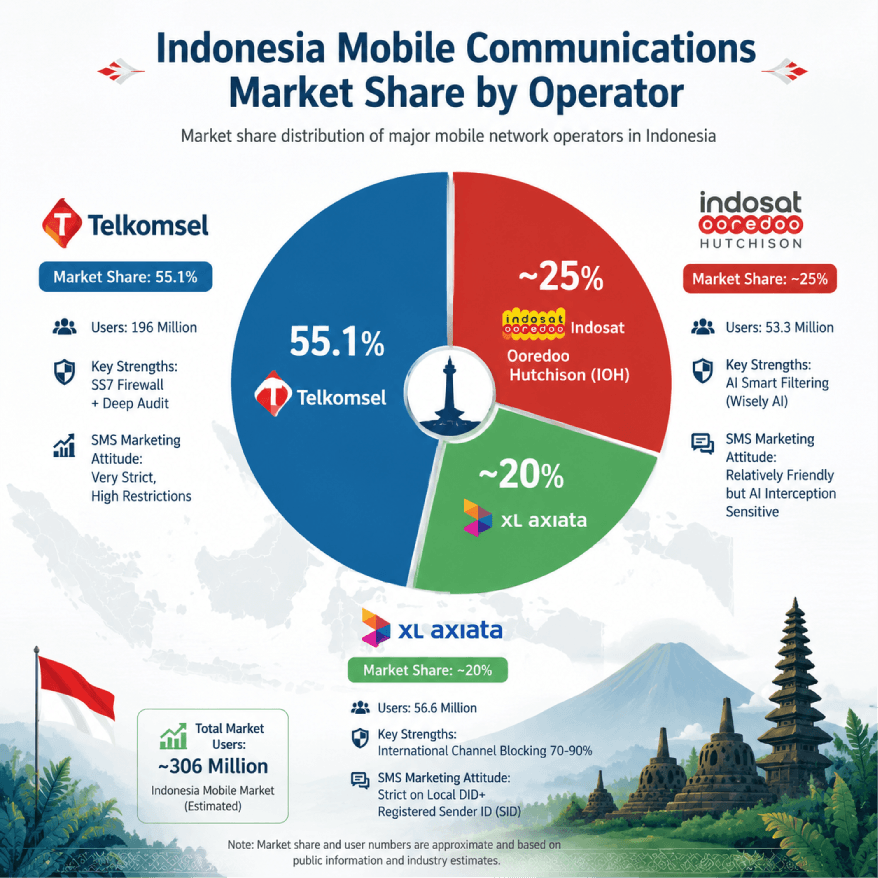
Summary: For companies wishing to achieve high delivery rates in Indonesia, choosing a cloud communication service provider with direct connection capabilities to the three major operators is key to ensuring reach quality.
Laaffic has established direct SMPP channels with Telkomsel, Indosat Ooredoo Hutchison, and XL Axiata, providing Indonesian local DID numbers and alphanumeric Sender IDs fully registered with the three major operators. The measured delivery rate is stable at over 96%, effectively avoiding the 70%-90% interception risk of international channels. From operator resource docking to Sender ID proxy registration, and from content semantic auditing to automatic unsubscription synchronization, Laaffic provides full-process, one-stop communication services for local Indonesian enterprises and is a trustworthy professional partner.
III. Key Trends and Challenges in SMS and Voice
In Indonesia, SMS and voice communication are at a point of contradictory intersection: companies are eager to reach 285 million users, while users are wary of unfamiliar messages; regulators are trying to purify the digital space, and operators are constantly raising technical barriers. Understanding the core challenges and evolution trends in this field is a prerequisite for formulating effective communication strategies.
Core Challenges: Survival Dilemma Under Triple Pressure
Currently, SMS and voice marketing in Indonesia are facing strong pressure from three levels: users, regulation, and technology.
Trust Pressure: 66% of Indonesians have encountered fraud, and 65% receive harassment SMS weekly. Users instinctively reject unfamiliar numbers. According to industry statistics, the proportion of legitimate SMS sent using international channels or unregistered Sender IDs being marked as spam by users is more than 3 times higher than that of registered brands.
Regulatory Pressure: Based on both religious and legal red lines, the Indonesian government is cracking down hard on online gambling. In the 18 months from October 2024 to April 2026, the Ministry of Communication deleted a cumulative 4.2 million pieces of negative content, with gambling accounting for 3.29 million (nearly 80%); in March 2026, Meta's rectification compliance rate was only 28.47%. On the financial side, 33,000 gambling-related accounts were frozen, and gambling fund flows dropped from 359 trillion to 155 trillion, a 57% decrease. This "content + funds" dual-line blockage warns that any communication touching red lines will be blocked, and sender identifiers may be permanently banned.
Technical Pressure: The three major operators filter non-compliant traffic through strict A2P specifications: mandatory alphanumeric Sender ID, each marketing message containing unsubscription instructions, no short links, and a single message limit of 160 characters. IOH's AI intercepted 2 billion+ high-risk contents in half a year, and suspicious phrasing may also be blocked. The delivery rate of international channels has dropped to 30%-60%, while compliant local channels can reach over 96%.
Key Trends: Communication Value is Being Reconstructed
Facing these challenges, the Indonesian SMS and voice market has not stagnated but is showing three clear directions of evolution.
Trend 1: SMS is upgrading from "marketing broadcast" to "digital identity extension." Data shows that the open rate of SMS with a registered Sender ID is more than 40% higher than that of international channels. Compliant channels are transforming from cost centers into brand assets.
Trend 2: AI Voice + SMS integration is fostering a new paradigm of high conversion.
The open and click-through rates of pure SMS marketing are declining year by year, while the voice answer rate remains stable at 40%-65%. Local Indonesian companies are beginning to experiment on a large scale with the combination strategy of "AI voice mass calling + hang-up SMS," which can increase the overall conversion rate by more than 40% compared to pure SMS.
Trend 3: CPaaS specialization is accelerating. The cost and complexity for companies to directly connect with the three major operators, complete Sender ID registration, and maintain SMPP connections continue to climb. The Indonesian CPaaS market is expected to grow from $91.02 million in 2025 to $406 million in 2029 (CAGR 34.87%). This means companies will no longer build their own communication capabilities but will choose professional CPaaS providers that can offer one-stop services such as localized direct channels, Sender ID proxy registration, content compliance auditing, and AI voice integration.
In daily operations, have you also encountered these situations?
The verification code is delayed during user registration, causing nearly half of new users to churn;
Users do not receive confirmation SMS for top-ups, and customer service is repeatedly questioned every day;
Carefully planned promotional SMS have a delivery rate of less than 60%;
Dormant users do not respond no matter how many SMS are sent, but you don't know that using AI voice plus hang-up SMS can double the response rate.
These scenarios are exactly the core problems that SMS and voice marketing need to solve. They involve specific business links such as verification codes, transaction notifications, marketing activities, and user recall——and these are the five major application scenarios that the next part will deconstruct one by one and provide practical solutions for.
Conclusion
That concludes the first part of "Deep Insights into Indonesian SMS and Voice Marketing." We have deconstructed Indonesia's economic foundation, the competitive landscape of operators, and the key trends and challenges facing SMS and voice. It can be seen that compliance and trust have become the core themes of the Indonesian communication market in 2026.
In the second part, we will further focus on: What is the true communication profile of Indonesian users? Facing the different rules of the three major operators, how should companies implement specific SMS and voice applications? What are the proven practical precautions? At the same time, we will also introduce the local communication service provider ecosystem in Indonesia in depth to help you build secure, efficient, and scalable communication capabilities.